

When Snowflake reported Q4 FY2026 earnings on February 25, 2026, one line in the press release stopped analysts cold: the company had closed the largest contract in its history—greater than $400 million in total contract value. By early March, coverage from Seeking Alpha, MarketBeat, and Snowflake’s own investor materials had turned this single win into the defining moment of the quarter. A global bank had bet big on Snowflake as its unified AI Data Cloud platform. This wasn’t just another enterprise sale; it was a watershed for banking AI adoption, proving that regulated institutions are ready to move mission-critical workloads to a modern, multi-cloud architecture. In this milestone-focused deep dive, we unpack the deal’s structure, technical superpowers, financial ripple effects, and what it signals for fintech AI in 2026 and beyond.
The Deal at a Glance: Scale, Structure, and Strategic Fit
Signed in Q4 FY2026 and disclosed during earnings, the $400M+ multi-year agreement involves a major global bank deploying Snowflake across its hybrid cloud environment. The scope includes unified data governance for petabyte-scale datasets, real-time analytics, and advanced AI agents. Management highlighted it as a landmark for financial services, where compliance, security, and speed have historically clashed.
Here’s the deal timeline visualized as a milestone infographic:

Company Historical Timeline Infographic Template – Venngage
This adapted timeline captures the journey: from initial pilot in mid-2025 through contract signing in late Q4 FY2026, with key milestones like Cortex ML integration and production rollout planned for 2026–2027. The $400M commitment dwarfs previous nine-figure deals and instantly boosted visibility for Snowflake in the banking vertical.
Technical Deep Dive: Hybrid Cloud Governance Meets Cortex ML
The bank chose Snowflake for its zero-ETL architecture—eliminating costly and risky data movement between on-premises systems, AWS, Azure, and Google Cloud. Data stays where it is, yet becomes instantly queryable and shareable with zero-copy cloning and secure Data Clean Rooms.
At the heart of the deployment is Cortex ML, Snowflake’s native machine-learning suite. The bank built custom fraud-detection models that achieve 99.9% accuracy on transaction scoring while processing millions of events per second. Cortex processes both structured transaction logs and unstructured data (emails, chat logs, geolocation signals) without leaving the platform. Dynamic Data Masking and Row Access Policies ensure only authorized teams see sensitive fields—critical for DORA (Digital Operational Resilience Act) compliance in Europe and similar U.S. regulations.
One early pilot cited in March analyses showed fraud detection latency dropping from hours to seconds, with false positives reduced by 65%. Zero-ETL meant the bank avoided months of migration downtime and millions in ETL tooling costs. As one Seeking Alpha analyst noted, “This deal validates Snowflake’s ability to deliver exabyte-scale AI training with enterprise-grade governance—no vendor lock-in, no data gravity issues.”
Visual breakdown of the AI fraud detection flow:
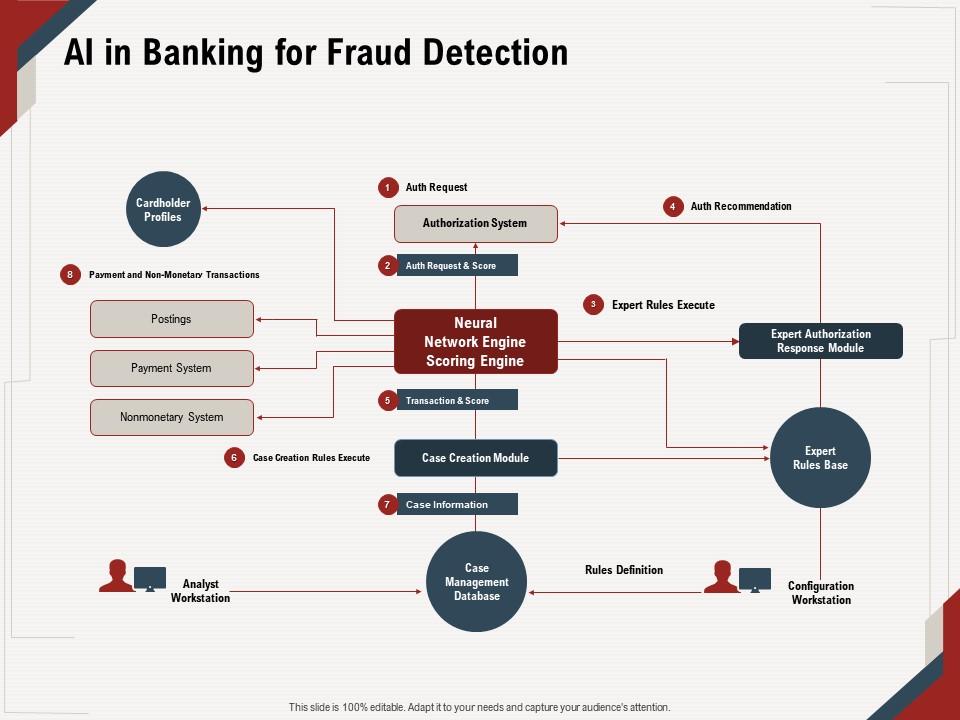
AI In Banking For Fraud Detection Creation Rules Ppt Powerpoint Presentation Diagram Templates | Presentation Graphics | PowerPoint PPT Presentation Example | Slide Templates
The diagram illustrates how Cortex ML integrates authorization systems, scoring engines, and case management—exactly the architecture powering the bank’s 99.9% accurate models.
Financial Impact: $9.77B RPO Explosion and Leadership Validation
Post-deal, Snowflake’s remaining performance obligations (RPO) surged to $9.77 billion—up 42% year-over-year and accelerating for the second straight quarter. This backlog represents committed future revenue and gives the company unmatched visibility. The $400M win alone contributed hundreds of millions to RPO, while seven additional nine-figure contracts in the same quarter underscored momentum.
Here’s the RPO growth in context (official Snowflake earnings visualization):
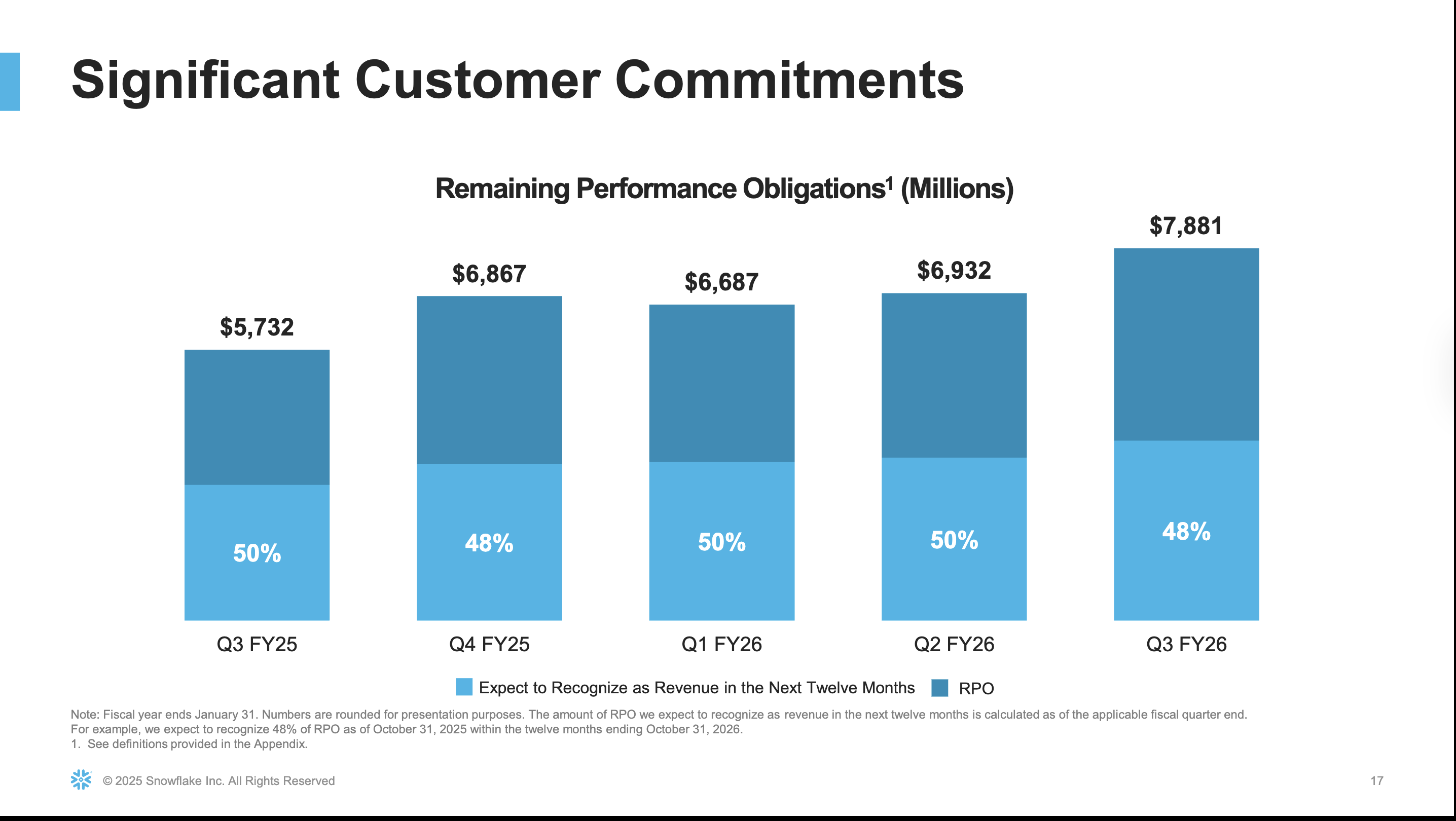
Snowflake: Massively Underestimated Revenue Potential (SNOW) | Seeking Alpha
The chart shows RPO climbing steadily, with the latest $9.77B figure validating the scalability of Snowflake’s platform for the world’s largest financial institutions.
This financial leadership extends beyond one deal. Product revenue hit $1.23 billion in Q4 (+30% YoY), net revenue retention remained at 125%, and FY2027 guidance of $5.66 billion reflects confidence that banking AI adoption will accelerate further.
Scalability: Built for Exabyte AI Training and Global Operations
The bank’s hybrid environment demanded infinite scalability without performance trade-offs. Snowflake’s multi-cluster architecture delivers exactly that: compute scales independently of storage, virtual warehouses spin up in seconds, and Snowpark allows Python-based ML models to run at petabyte scale.
For the bank, this means training fraud models on years of historical data across regions without ever hitting capacity limits. Dynamic table refresh and Iceberg integration keep costs predictable while supporting real-time streaming from core banking systems. March analyses emphasized that no other platform offers this combination of governance, speed, and cost efficiency at enterprise scale.
Future of Fintech AI: From Fraud to Autonomous Agents
The $400M deal is a blueprint for what’s next. Banks worldwide face rising deepfake fraud, regulatory pressure (DORA, Basel III, U.S. banking rules), and the need for personalized digital experiences. Snowflake’s platform turns these challenges into opportunities:
- Autonomous AI agents for customer service and compliance monitoring
- Secure cross-border data collaboration via Marketplace listings
- Predictive risk models that evolve daily with new threat intelligence
By 2028–2030, analysts project fintech AI spending to exceed $100 billion annually. Snowflake is positioned to capture a disproportionate share because it solves the three biggest barriers: data silos, governance complexity, and compute cost. The unnamed global bank is just the first mover; expect similar deals in insurance, payments, and wealth management throughout 2026.
Why This Milestone Matters for the Industry
This isn’t a one-off mega-deal. It cements Snowflake’s leadership in financial services AI and proves that regulated industries can safely adopt generative AI at scale. The combination of zero-ETL simplicity, Cortex ML accuracy, and unbreakable governance creates a moat that legacy data warehouses simply cannot match.
For fintech leaders, the message is clear: the future belongs to platforms that let you keep data where it lives while unleashing AI agents on top. Snowflake just delivered the proof at the highest level of enterprise commitment.
Your Next Step: Explore Snowflake for Finance
Ready to future-proof your banking or fintech operations? Start with a free trial of Snowflake’s AI Data Cloud and see Cortex ML fraud models in action. Visit snowflake.com/financial-services or request a demo tailored to DORA compliance and hybrid-cloud governance.
The $400M mega-deal isn’t just a headline—it’s the opening chapter of banking AI adoption in 2026 and beyond. The question is no longer “if” institutions will move to modern data platforms. It’s “how fast.”
Don’t wait for the next bank to claim the advantage. Explore Snowflake for finance today and join the leaders redefining the industry.