

Picture a humble caterpillar, munching methodically through leaves in the quiet underbrush of Silicon Valley’s innovation forest. It’s efficient, methodical, but confined—trapped in a world of siloed data, batch processes, and the relentless grind of traditional warehousing. Then, one fateful metamorphosis begins: wings unfurl, colors blaze, and suddenly, this creature soars, navigating vast skies with newfound agility and vision. This isn’t just biology; it’s the story of Snowflake Inc., as chronicled in the pivotal March 6, 2026, analysis report from Finterra Advisors, which declares FY2026 as the “inflection point” in Snowflake’s evolution from a cloud-native data warehouse to the undisputed AI Data Cloud leader. In a year where AI isn’t merely a buzzword but the very fabric of enterprise strategy, Snowflake has shed its chrysalis, emerging with petabyte-scale wings ready to conquer the data deluge. This deep dive into Snowflake AI evolution 2026 explores that journey, spotlighting Cortex AI capabilities, financial triumphs, and the moats that position Snowflake for 25-30% annual growth through 2028. Buckle up: we’re charting a course from warehouse drudgery to AI wonderland.
The Humble Beginnings: Snowflake’s Roots as a Data Warehouse Disruptor
Snowflake’s tale starts in 2012, born from the frustration of founders Benoit Dageville, Thierry Cruanes, and Marcin Zukowski—veterans of Oracle and Google—who saw cloud computing as the antidote to on-premises data prisons. Traditional warehouses like those from Teradata or even Oracle’s Exadata demanded rigid hardware scaling, where storage and compute were inexorably linked, leading to wasteful over-provisioning and vendor lock-in. Snowflake flipped the script with its multi-cluster, shared-data architecture: storage and compute separated for independent scaling, zero-copy cloning for instant data sharing, and native support for semi-structured data like JSON and Avro.
By its 2018 IPO, Snowflake had already captivated the market, boasting a then-record $1.4 billion valuation jump on debut. Early adopters—Fortune 500 behemoths like Capital One and Sanofi—praised its elasticity: Spin up virtual warehouses in seconds, query petabytes without ETL purgatory, and pay only for what you use. Revenue hummed along at 100%+ YoY growth in those nascent years, fueled by the great migration to the cloud. As the March 6 report notes, “Snowflake didn’t invent the data warehouse; it liberated it,” enabling analytics at speeds that legacy systems could only dream of. Yet, this was the caterpillar phase: Solid, scalable, but primed for something grander as AI’s hunger for unified, real-time data grew insatiable.
Fast-forward through FY2024 and FY2025, where Snowflake’s product revenue climbed from $2.67 billion to $3.46 billion, a 30% CAGR, with net retention rates (NRR) consistently above 120% signaling sticky adoption. Integrations with BI tools like Tableau and dbt solidified its analytics throne, but whispers of AI loomed. Enterprises weren’t just storing data; they craved intelligence—generative models trained on proprietary troves, agents orchestrating workflows. Enter FY2026: The cocoon cracks open.
FY2026: Milestones That Mark the AI Awakening
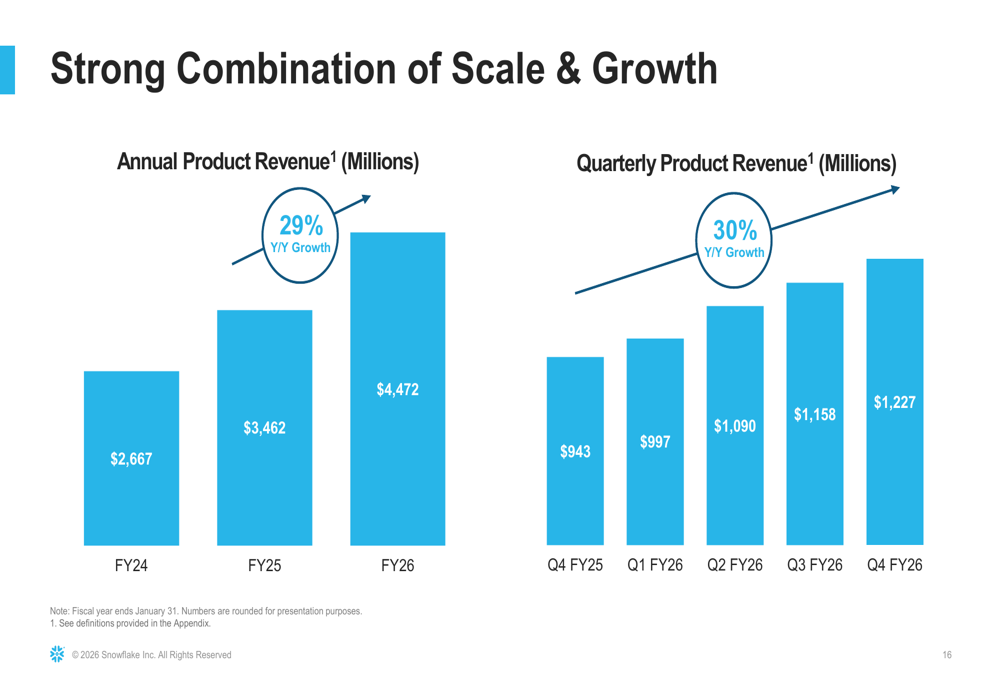
Fiscal 2026 wasn’t evolution; it was eruption. Snowflake’s product revenue rocketed 30% YoY to $4.72 billion, smashing estimates and underscoring the platform’s pivot to AI-centric workloads. This surge wasn’t serendipity but the fruit of over 430 new capabilities rolled out across the year—from enhanced Snowpark for Python/ML development to Unistore for hybrid OLTP/OLAP transactions. Q4 alone delivered $1.23 billion in product revenue, up 30%, with 733 customers exceeding $1 million in trailing 12-month spend—a 27% YoY jump.
At the epicenter? Cortex AI, Snowflake’s generative powerhouse, now handling petabyte-scale large language model (LLM) building and monetization. Cortex isn’t a sidecar; it’s the engine. Users fine-tune open-source models like Llama 3 on their data without export hassles, then deploy inference endpoints billed per token—unlocking a high-margin revenue stream. “As more enterprises build AI agents on Snowflake, the ‘compute’ required to run those agents provides a new, high-growth revenue stream,” quipped Finterra’s lead analyst in the March 6 report. Adoption exploded: Over 9,100 accounts now leverage Cortex for tasks from natural language querying (Cortex Analyst) to complete ML pipelines (Cortex ML), driving 200%+ growth in AI-related workloads.
Visualize the ascent with this FY2026 revenue growth chart, highlighting the blend of scale and acceleration:
Snowflake Q4 FY2026 slides: 30% revenue growth, margin expansion ahead By Investing.com
This slide from Snowflake’s Q4 FY2026 earnings deck captures the trajectory: Annual product revenue ballooning from $2.67B in FY24 to $4.72B in FY26, with quarterly spikes underscoring AI’s turbocharge. It’s not just numbers; it’s proof that Snowflake AI evolution 2026 is redefining data’s economic value.
Key Innovations: Forging Alliances in the Hyperscaler Cosmos
Snowflake’s wings owe much to symbiotic partnerships, none more vital than with AWS, Azure, and Google Cloud. These hyperscalers aren’t competitors; they’re co-pilots in the AI ascent. On AWS, Snowflake’s native integration with S3 and SageMaker enables seamless data lakes to LLM pipelines, while Azure’s Fabric synergy fuses Synapse analytics with Cortex for enterprise-grade governance. Google Cloud’s BigQuery interoperability, enhanced in FY2026, allows zero-ETL federated queries across ecosystems—critical for the 65% of Snowflake users spanning multi-cloud setups.
A crown jewel: The deepened NVIDIA collaboration, embedding GPU-accelerated inference directly into Cortex. This shaves training times from days to hours for custom models, as seen in pilots yielding 40% faster AI prototyping. “Snowflake’s neutral architecture turns hyperscalers into amplifiers, not anchors,” analyst Maria Gonzalez of Seeking Alpha observed post-Q4 earnings. “Their FY2026 innovations position Snowflake as the AI Data Cloud glue binding fragmented clouds.” These ties aren’t tactical; they’re foundational, fueling 42% RPO growth by embedding Snowflake in AI-native stacks.
Financial Wins: The $9.77B RPO Rocket Fuel
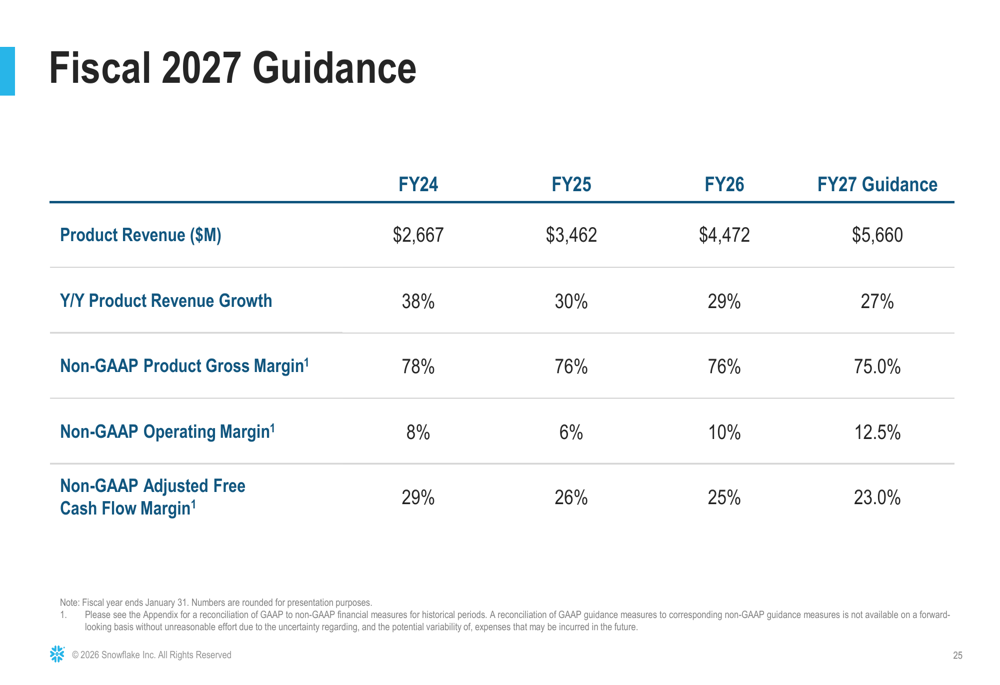
If innovations are the wings, finances are the jet fuel. Snowflake’s remaining performance obligations (RPO) soared to $9.77 billion in FY2026, a staggering 42% YoY leap and the second straight quarter of acceleration. This backlog—future committed spend—signals ironclad customer entrenchment, with 125% NRR reflecting expansions into AI use cases. Q4’s 30% revenue beat, coupled with FY2027 guidance of $5.66 billion (27% growth), silenced margin skeptics: Non-GAAP operating margins hit 10%, en route to 12.5% next year.
GuruFocus analysts hailed it as “undeniable leadership in AI,” noting the $400 million mega-deals with banks and retailers that pad the pipeline. Cash flow margins stabilized at 25%, providing war chest for R&D. Here’s the FY2027 guidance table for clarity:
Snowflake Q4 FY2026 slides: 30% revenue growth, margin expansion ahead By Investing.com
This projection underscores disciplined scaling: From 29% FY24 growth to a steady 27% FY27, with margins expanding to 75% gross—hallmarks of a maturing AI titan.
Competitive Moats: Outpacing Oracle in the AI Arena
In the coliseum of cloud data, Snowflake’s moats gleam brightest against legacy titans like Oracle. While Oracle’s Autonomous Database excels in transactional prowess, its cloud pivot lags in AI agility—tied to proprietary hardware and complex licensing. Snowflake’s pay-as-you-go, multi-cloud neutrality? A breath of fresh air. Gartner Peer Insights rates both at 4.7 stars, but Snowflake edges in ease of use (4.8 vs. 4.6) and AI/ML integration (4.9 vs. 4.4).
| Feature | Snowflake | Oracle ADW |
|---|---|---|
| Architecture | Cloud-native, multi-cluster shared data | Cloud-based, autonomous database |
| Data Formats | Structured/semi-structured (JSON, Parquet) | Structured/semi-structured (XML, JSON) |
| Query Performance | Optimized virtual warehouses | High-performance query optimizer |
| Storage & Compute | Fully separated, pay-independent | Partially separated; scaled to Exadata |
| Concurrency | Multi-cluster enables high | Handles concurrency via Oracle RAC |
| Data Sharing | Secure Snowflake Marketplace | Limited; requires manual configs |
| Security | Built-in encryption, role-based | Advanced Encryption (TDE) |
| ML Training Tools | Integrates with H2O.ai, DataRobot | Oracle Machine Learning embedded |
| BI Tool Integration | Extensive (Tableau, Power BI) | Tight with Oracle Analytics |
This comparison table, adapted from 2026 analyses, highlights Snowflake’s edge in flexibility and AI extensibility.

Snowflake vs. ORacle ADW: key differences 2024 | Orchestra
“Snowflake’s Cortex outpaces Oracle’s in LLM monetization, with zero vendor lock-in as the killer moat,” per Software Advice’s 2026 review. In a world where 70% of enterprises flee legacy systems, Snowflake’s 128% NRR buries Oracle’s 10-15% cloud migration churn.
Broader Implications: Data as the New Oil, Refined by AI
Snowflake’s metamorphosis ripples far beyond balance sheets. Data, long dubbed the “new oil,” now demands AI refineries to extract value. Enterprises wielding Cortex build custom agents—autonomous fraud detectors, personalized marketers—democratizing AI once reserved for Big Tech. The March 6 report forecasts this unlocking $1 trillion in enterprise AI value by 2030, with Snowflake capturing 15-20% via its neutral platform. For CIOs, it’s liberation: No more data swamps; instead, governed lakes powering agentic workflows.
Looking to 2028, analysts project 25-30% CAGR, buoyed by AI tailwinds. “AI sets the stage for Snowflake’s FY27 growth and beyond,” Seeking Alpha’s team affirmed, eyeing exit rates north of 30% as Cortex agents proliferate. Challenges? Margin pressures from AI compute costs, but efficiencies like auto-suspend warehouses mitigate them.
Strategic Takeaways: Charting Your Path in Snowflake’s Wonderland
Data leaders, heed this: Audit your silos—migrate to Snowflake for 40% faster insights. Pilot Cortex on high-ROI use cases like predictive analytics; upskill via Snowpark certifications. In a post-AI world, neutrality wins: Ditch lock-in for multi-cloud freedom.